blog how to, blog trick, blog tips, tutorial blog, blog hack

HEADLINE NEWS

Popular Posts

Showing posts with label politics. Show all posts

Friday, January 21, 2011

Your questions, your State of the Union

(Cross-posted from the YouTube Blog)

It’s the biggest speech of the year, and next Tuesday night at 9 p.m. ET, people across the country and around the world will sit down to watch. But as President Obama delivers the 2011 State of the Union Address, which will be streamed live on YouTube along with the Republican response, you can do more than just watch the speech: you can also submit your questions for the President for an exclusive YouTube Interview that will take place just two days later, on January 27.

In fact, you can get started today. Health care. Education. Foreign policy. What would you like to ask the President about the most important issues our country faces? Go to youtube.com/askobama to submit your question now, or watch the speech on Tuesday night with your webcam or video camera nearby so that you can record and submit your question as soon as it strikes you. This year, you'll also be able to ask your question via Twitter: just include the hashtag #askobama in your tweet. And be sure to have your say in what should be asked by voting on questions submitted by others, too.


A few suggestions before submitting your questions:
  1. Video questions are highly preferred (though we also accept text). Videos should be about 20 seconds long and be sure to ask the question directly.
  2. Speak clearly and try to film in a place with minimal background noise. Keep the camera as still as possible.
  3. Feel free to be creative (use props, charts, etc.) to help your question stand out. If you have time, find an interesting backdrop that may help reinforce your message.
  4. Submit your question early. The final deadline is Wednesday January 25 at midnight ET.
President Obama’s responses to a selection of your top-voted questions will be streamed live from the White House on youtube.com/askobama at 2:30 p.m. ET on Thursday January 27.

This interview is the first in a series of world leader interviews coming to YouTube in 2011 as part of YouTube World View. These interviews will give people around the world the chance to engage in conversation with their elected officials and other influential people from the world of business, philanthropy, technology, media and the arts. Check back on the channel in the next few months for more opportunities to participate.

You have until Wednesday, January 25 at midnight ET to submit your question for President Obama. The YouTube community made history last year when the President answered your questions in the first ever citizen-powered interview of a United States president. If you didn’t get an opportunity to ask the President a question last year, make sure you don’t miss out this time—get your submission in early.

Remember, after the President’s address you’ll have the opportunity to watch Congressman Paul Ryan (R-WI) deliver the GOP response to the State of the Union as well. And within the month, we’ll be holding a similar YouTube Interview with a prominent Republican leader—more details soon.

Wednesday, November 3, 2010

More midterm election search trends as the results come in

As Election Day went on, people continued to come to Google for information and, importantly, updates on results. Starting around 8pm PT yesterday, Nov 2, and continuing throughout the night and into the morning, more than half the terms in Hot Trends were related to the election. People searched for [live election coverage] as well as news sites like [fox news] and [drudge report]. Most of the popular searches, however, were for certain races and candidates, starting mostly with races in the Eastern time zone and gradually moving west as polls closed across the country.

The hot terms included Senators-elect [marco rubio] of Florida, [dan coats] of Indiana and [rand paul] of Kentucky, three Republicans who won yesterday, as well as incumbent Democrats Sen. [blanche lincoln] of Arkansas and [russ feingold] of Wisconsin, who lost, and Democrat Joe Manchin of West Virginia, who won the special Senate election to take Robert Byrd’s former Senate seat. [joe sestak], Pennsylvania’s Democrat candidate for Senate, was also popular online, as well as [joe toomey], who defeated him. People also looked for information on the [delaware senate race] which had gained national attention largely due to Republican candidate Christine O’Donnell (she lost).

Beginning around 9pm PT, we saw interest rising in the [nevada senate race], the outcome of which would determine whether Majority Leader Harry Reid would stay in office. Searches for [harry reid polls] and [nevada election results] continued to be popular even after it was announced that he had won. California’s incumbent Democrat Sen. [barbara boxer], who also won her reelection bid, was also popular search. And the still-undecided Alaska Senate race continues to drive searches, especially for the write-in candidate there, [lisa murkowski].

In the House of Representatives, we’ve seen searches spike for Rep. [nancy pelosi], who won her California district last night but lost her position as Speaker of the House when the Republicans gained the majority in the house. Her successor as Speaker, [john boehner], was also popular. And there was interest in reelected candidates from both sides of the aisle, from Democrat [barney frank] of Massachusetts to Republican [michele bachmann] of Minnesota.

Popular Governors’ races include Ohio, Florida (people are also looking for info about its winner as of this morning, [rick scott]), Texas, Illinois, Connecticut, South Carolina (which elected its first female governor last night, [nikki haley]) and Minnesota, where the winner has yet to be decided as of this moment. [emmer], the Republican candidate there, is in the top 20 list on Hot Trends as of 8am PT this morning.

California’s prop 19, which lost by an estimated 10 percentage points, continued to be popular online, as people checked for [prop 19 results] [prop 19 status] and [prop 19 poll numbers], asking [did prop 19 pass in california].

Some East Coast residents seem to have gone to bed before the results came out last night, and are catching up on the news this morning. Searches for New England newspapers [portland press herald], [hartford courant], [burlington free press] and [bangor daily news] took up a fifth of the Hot Trends list at 8am PT today, along with searches for [tallahassee democrat] and [columbus dispatch].

Finally, it wasn’t just current candidates who made news last night. Former vice presidential candidate [geraldine ferraro] was popular online; Ferraro appeared on TV last night with her fellow VP candidate Sarah Palin, and the former made some comments about female candidates for president in 2012 that had some people raising eyebrows. People were also interested in [obama trip to india], the President’s trip planned for this weekend.

That’s it for now, but we’ll keep an eye on the search trends—and on the news—and see if we have any more interesting tidbits to share.

Tuesday, November 2, 2010

More midterm election search trends

Election Day is finally here in the U.S., and many people are turning to the web to get information before heading out to vote. On Hot Trends at 1pm PT today, 13 of the top 20 searches were election-related, most of which had to do with figuring out where to vote. Terms like [polling place locator], [voting locations by zip code] and [where do i vote] have been popular all day, as well as state-specific searches like [nc board of elections] and [where to vote in minnesota]. Others are turning to the Internet to ask how long they have to vote, with searches like [what time do the polls close]. And earlier today, we even saw a handful of hot searches like [am i registered to vote in texas] and [voter registration]—apparently some well-meaning citizens have left one important part of the process until the last minute!

Of course, many people are also looking to make decisions about how to vote. The terms [vote smart] and [voters guide] have been popular today, indicating that people are trying to squeeze in some research before heading to the polls. Naturally, searches for various candidates, from [bill white] of Texas to [charlie baker] of Massachusetts, have increased today as well. Other searches like [massachusetts ballot questions 2010], [oklahoma state questions] and [amendment 4 florida] spiked this morning as people look for information about statewide measures. And at 1pm PT, three of the top 20 terms on Hot Trends had to do with California's proposition 19.

People are also already looking to get information about returns—searching for [exit polls 2010], [gallup poll], [voter turnout], [2010 election results] and [voting results], even though polls don’t close on the East Coast for several more hours.

Looking back over this past weekend, we saw a steady stream of political searches coming in. Search volume for California Republican Senate candidate Carly Fiorina spiked last Friday when news broke that she had entered the hospital for an infection, but searches for Fiorina have since dropped below those for her opponent, Sen. Barbara Boxer. And amidst growing speculation about the possibility of his becoming Speaker of the House (and back-and-forth barbs with President Obama over the weekend), searches for Republican House Minority Leader John Boehner rose steadily across the country. Finally, last weekend was the culmination of nearly two months of national interest in Jon Stewart and Stephen Colbert's Rally to Restore Sanity and/or Fear. On Saturday, October 30, more than half the terms on Hot Trends were related to the rally, and related searches like [comedy central rally] and [keep fear alive] have exploded, increasing by more than 5,000% in several cases.

We’ll be back later on with the latest on our election search trends. Until then, go find your polling place and vote!

Saturday, October 30, 2010

Handy tools to help Americans vote

As Americans gear up for the midterm elections on November 2, we wanted to share a few tools that make it easier to gather voting information.

When you search on Google for [polling place] or [where to vote], you’ll see a search box to help you find your polling place, candidates, and local election office. Just type in the home address where you’re registered to vote. The search looks like this:


This feature is powered by the Google Election Center, an experimental service that lets election officials provide data directly to Google in order to create a set of search tools. Anyone with a website can also provide this same functionality by embedding the open source Election Center gadget on your site, or use the gadget code or API to build your own.


And you don’t need to be at your computer to easily find this information. If you’d rather get it on your mobile device, we’ve also created a mobile landing page: m.google.com/elections.


As for election news, you’ll find a special Google News section with stories for each state so you can easily catch up on the latest headlines.


We hope all of these tools help you get and stay informed throughout the election season.

Wednesday, October 27, 2010

Searching your way to the ballot box

With less than a week left until the U.S. 2010 midterm elections, interest is heating up around the country—in polling places, close races and hot political issues. We thought we’d peek into the search data to see what we could find about what kinds of info people are looking for as they get ready to go to the ballot box next Tuesday. We used a combination of Insights for Search and internal tools to dig up this data, and all searches studied are anonymous.

Over the past few months, we’ve seen rising searches for things like [voter registration], [early voting] and [absentee voting] as people prepare for Election Day. People are also looking for information on [polls] (check out our elections rating site to compare expert predictions). What are the issues occupying people’s mind as they choose who to vote for? Looking at the most popular searches on Google News in October, the issues that stand out are the economy (we continue to see many searches for terms like [unemployment] and [foreclosures]), as well as immigration and health care.

At our headquarters in California, we’re of course paying close attention to two high profile races in this state: the Senate race between Carly Fiorina and incumbent Barbara Boxer, and the governor’s race between Meg Whitman and Jerry Brown. Looking the gubernatorial candidates, Brown has been leading in the polls recently, but in the search race, Whitman has the edge, with more than 50% more search volume in 2010 than Brown. Fittingly, Sacramentans are more likely to search for both Whitman and Brown, followed by Angelenos and then San Franciscans. Popular related searches show people looking for information about polling data as well as the candidate debates: we saw searches spike for both candidates on September 29 and October 13, two days that followed debates. There was also a spike around the time of the primary election on June 8, as well as on October 8, when a controversial comment by an aide of Brown’s hit newsstands.

We also wanted to find out what the big issues people were interested in about each candidate. Naturally, we saw a lot of searches for things like [meg whitman bio] or [jerry brown wikipedia], as well as [meg whitman ad] or [jerry brown platform] and vice versa. Terms more specifically related to Meg Whitman include [housekeeper] and [immigration]—reflecting interest in reports that Whitman had employed an undocumented worker as her housekeeper, and corresponding interest in the candidate’s views on immigration and immigration reform. People also want to know about her history at [ebay] and about her family (with the terms [husband] and [children] showing up in searches related to Whitman). But this being California, people are also looking for information about how Whitman would approach the problem of the state’s budget and economy—after immigration, the next issue we saw turn up in terms related to Whitman was [spending]. Interestingly, immigration was also the number one issue in searches related to Jerry Brown. People also seem to be looking for information about Brown’s previous term as governor, and, as with Whitman, we’re seeing searches for information about his [wife].

There’s also growing interest in one of the propositions on California’s ballot this year: Proposition 19, which would legalize and allow regulation of certain marijuana activities. Even though Prop 19 is a state initiative, its implications have people across the country searching for information about it:


Moving across the country, another state that’s grabbed headlines during this primary season is Delaware. Prior to her upset win in the Republican primary against former governor Mike Castle in September, searches for Senate candidate Christine O’Donnell were minimal—even though she’d been in the running since March. Since then, however, she’s been a subject of conversations across the country and searches for her name have consequently risen as well.


Searchers looked for information on a comment O’Donnell made on Bill Maher’s show in 1999 about [witchcraft]—it’s one of the top terms related to searches for O’Donnell. People also are interested in an [snl] spoof of O’Donnell earlier this month. O’Donnell is clearly outmatching her Democrat opponent Chris Coons in search, but only time will tell how the votes play out.

The potential shift in power in the House and Senate following these elections has people closely watching a handful of races to see which party comes out on top. We took a look at the Insights for Search graphs for a handful of close races and races that are considered influential. Take a look at the links below to see more, and plug in the names and other states of other candidates to try it out for yourself:
Of course, no discussion of this election season would be complete without a look at the Tea Party. The grassroots movement has captured the nation’s attention, and has people looking for information about the history of the original Boston Tea Party and related events, like the [boston massacre] and the [tea act], in addition to the more expected searches for information on [tea party rally] or [tea party platform] and figures like [sarah palin] and [glenn beck].

And finally, we’ve also seen some popular political rallies in the past few months. Glenn Beck’s Restoring Honor Rally in Washington, D.C. in late August kicked things off, and inspired Stephen Colbert and Jon Stewart to host their own events—the March to Keep Fear Alive and the Rally to Restore Sanity, respectively—both of which are taking place this coming Saturday in D.C. Searches related to all of these rallies, especially Stewart’s, have seen huge increases in volume—above 5000%.


We’ll be back soon with more search trends and other information about the mid-term elections. In the meantime, don’t forget to vote!

Friday, September 24, 2010

Discussing innovation and democracy in 2010

Over the past few U.S. election cycles, Google and YouTube have have become catalysts for a more engaging, meaningful dialogue between citizens and government leaders. From asking questions of candidates to finding your polling place, our tools are helping to make elections and politics more personal and more democratic, and have opened up Washington, D.C. in exciting new ways.

With less than six weeks until the midterm elections, we wanted to hear from some of politics’ most creative minds about what innovation and democracy mean in 2010. So on Monday we’re joining forces with POLITICO to host an event at the Newseum in Washington, D.C., where we’ll discuss the increasing contributions of technology to democracy and the political process.

As part of the event David Axelrod and Ed Gillespie will answer questions and offer thoughts and predictions about the upcoming elections. Arianna Huffington will then moderate a panel about innovation in media, and will be joined by Becki Donatelli, Stephen Hayes, Nate Silver and Amy Walter. We’ll also demonstrate tools built for citizens and government officials using YouTube and Google Maps, and will be joined by our friends on the politics team at Facebook.

The panelists want to hear from you, so if you’d like to submit a question for any of them, you can do so at youtube.com/citizentube. You’ll also be able to watch the entire event live on YouTube on Monday.


As we approach the election homestretch, we’ll continue to develop useful ways for voters and campaigns to engage one another around the important issues in 2010.

Tuesday, September 21, 2010

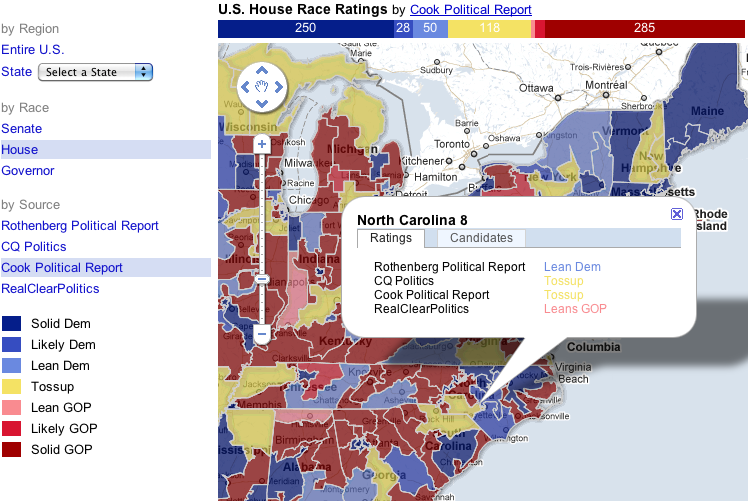
Shades of red, shades of blue: mapping midterm election ratings

With the midterm elections in the U.S. just six weeks away, everyone is wondering how the balance of power between Republicans and Democrats will shake out after November 2. Although more than 500 seats will be decided in House, Senate, and Governor races, the current tallies are so close that individual races are receiving great scrutiny: you’ll find several sources providing estimations for how each race is leaning.

To make tracking the blues and reds a little easier for armchair pundits, we’ve partnered with some of the most respected names in politics—Cook, Rothenberg, CQ-Roll Call and RealClearPolitics—to put their ratings in the same place and on the same map. You can find it at maps.google.com/elections2010.


The map initially shows loads with states shaded according to one of the sources’ ratings of the Senate race; click the links on the left to switch to House or Governor races, or to switch sources. To compare the ratings head-to-head, click a given state or district, and you’ll see ratings from each source displayed. We refresh the data daily based on the latest ratings, so come back as the races develop. If you would like to put this map in your own website, you can embed it as a gadget and grab the code here.

This gadget is powered by the highly flexible yet simple-to-build-on Fusion Tables, which directly integrates into Google Maps API v3. Even if you’re not a programmer, there's a lot that you can do with Fusion Tables to manipulate and visualize data, and in the spirit of the season, check out our new tutorial that demonstrates how to analyze Census data by congressional district and share what you’ve come up with.

Along with other initiatives, including the Election Center with our Public Sector team and You Choose at YouTube, this map gadget is an important way that we’re working to improve communication, discourse and understanding of the political process.

Tuesday, June 15, 2010

The White House takes your questions about the oil spill on YouTube

(Cross-posted from the YouTube Blog)

Tonight at 8 p.m. ET, watch President Obama live on the White House YouTube channel as he addresses the nation about the Gulf oil spill. Then 15 minutes after the remarks, White House Press Secretary Robert Gibbs will answer your questions. Starting right now, you can submit questions about the disaster on Google Moderator, and vote the best ones to the top. Hear more from Mr. Gibbs:


Already, the conversation about the oil spill on the web has been lively. Earlier this month, thousands of you submitted your ideas on how to clean up the oil spill on YouTube, several of which were aired during the PBS NewsHour. And as more and more Americans are searching on Google to find information about the oil spill and cleanup efforts, we want to help you connect directly with the recovery process.

Now’s your chance to hear the White House’s response to your questions about what many are calling the worst man-made environmental disaster in U.S. history. Submit questions now and vote on the ones you think are most important; then tune in tonight to watch the President’s address live on YouTube.

Thursday, June 3, 2010

Inform, engage and mobilize voters with YouTube and Google Campaign Toolkits

(Cross-posted from the YouTube Blog)

It’s no secret that any successful 21st century political campaign must have a robust online strategy to succeed. But elected officials and candidates need more than just a website and a YouTube channel to engage voters: from President Obama’s YouTube interview to Senator Scott Brown’s campaign team’s use of Google Docs to Congressman Scott Murphy’s “Google blast” ad strategy, we’re seeing politicians use more and more of our products and platforms to interact with voters, share information and keep their campaigns organized.

We want to do our part to make sure candidates and campaigns have the tools to stay close to voters, who now expect to hear and see much more from their elected officials than ever before. So today, we’re launching YouTube’s You Choose 2010 Campaign Toolkit and a new and improved Google Campaign Toolkit. Both help candidates make their organizations more effective and deliver their messages more directly. On YouTube, campaigns will have access to features like a Politician channel (which allows campaigns to brand their channel and upload longer videos), Google Moderator, our free analytics tool YouTube Insight, and information about running paid advertising campaigns—using formats like in-stream ads and Promoted Videos—to reach viewers with political ads, just like on TV. And our Google toolkit demonstrates how Google Apps can keep staff and volunteers connected, how search ads can grow your email list and provides other helpful tools.

We hope campaigns in both national and local contests will use these toolkits to engage and inform voters on important issues in 2010. As access to information online is increasingly important in elections, we’re pleased to continue developing useful tools for voters and candidates.


Wednesday, March 10, 2010

The Internet in America: A YouTube Interview with the FCC

(Cross-posted from the YouTube Blog)

If you're reading this, then you're probably on the Internet — via your laptop, your mobile phone or other handheld device, or maybe even through your television. But in 2010, millions of Americans still do not have access to the wealth of information made available on the Web. Even though the Internet was invented in the U.S. over 20 years ago, many Americans lag behind in both access to the Internet and speed of connections, which is why the Federal Communications Commission (or the FCC, the federal agency that oversees the U.S. communications industry) is launching its much-anticipated National Broadband Plan next Tuesday, to lay out its strategy for connecting all Americans to fast, affordable high-speed Internet.

After this plan is announced, you have the opportunity to interview FCC Chairman Julius Genachowski, in the second of a series of in-person YouTube interviews with government leaders. (Our first, with U.S. President Barack Obama, took place last month.) Go to CitizenTube today to submit your video or text question via Google Moderator, and vote on your favorites; we'll bring a selection of the top-voted questions to Chairman Genachowski in our interview next Tuesday, March 16. The deadline for submission is Sunday night, March 14, at 11:59 p.m. PT.

To help structure our conversation with the Chairman, we've broken the interview down into seven topics. To learn more about what the FCC is doing in each area, click on the links for each topic below. Then submit your question on CitizenTube under one of the topic headings.
Access to the Internet has transformed almost every aspect of our economy and society. This is your chance to press the FCC on how the National Broadband Plan will work, and ask your questions about improving the Internet in America. We're looking forward to seeing your questions and hearing what the Chairman has to say.

 
My Ping in TotalPing.com